
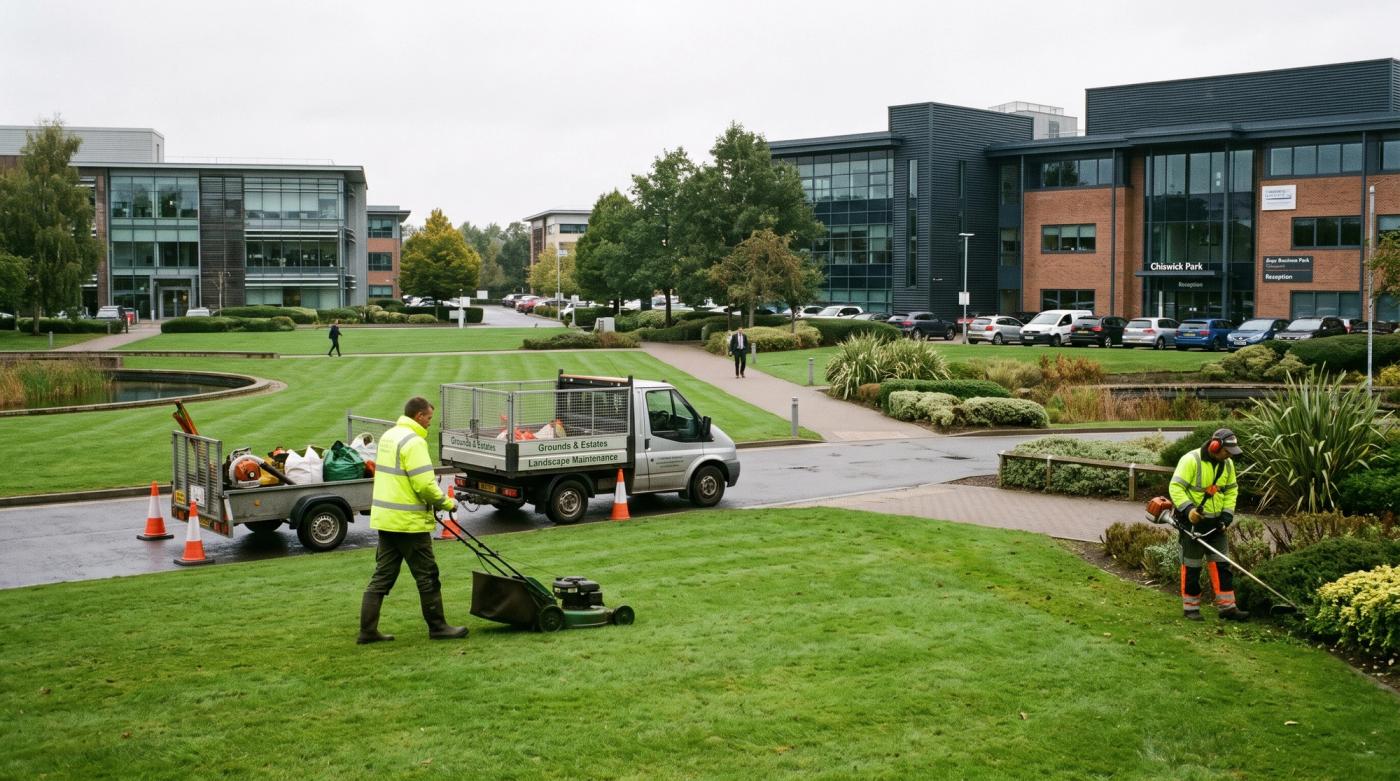
A council needs its parks maintained. A business park needs its grass cut. A property management company needs someone to look after the grounds across several commercial sites.
Some of these opportunities appear as advertised grounds maintenance tenders. Others are awarded through supplier relationships, quotations and private procurement processes.
If you run a grounds maintenance or commercial landscaping business, knowing where to look — and who to approach — can make a substantial difference to the contracts you win.
There are two main routes: find organisations actively inviting bids, or build relationships with potential customers before their next contract becomes available.
The second route is where MoreAboard can help, researching businesses that resemble the customers you'd most like to work with. But first, let's look at where you can actually find grounds maintenance tenders.
1. Where to find grounds maintenance tenders in the UK
Public bodies advertise grounds maintenance contracts through procurement platforms. These are useful starting points because they let you identify organisations actively purchasing services, rather than guessing who might need a contractor.
Find a Tender
Find a Tender is the UK's official service for finding public procurement opportunities covered by its publication arrangements.
Search for terms such as:
- Grounds maintenance
- Landscape maintenance
- Grass cutting
- Open space maintenance
- Horticultural services
- Estate maintenance
Not every relevant contract will use the words "grounds maintenance" in its title.
A council might advertise an open spaces maintenance contract covering grass cutting, shrub maintenance and litter collection.
Another organisation might include landscaping within a broader facilities management contract.
Read the actual specification before deciding whether an opportunity fits your services.
Contracts Finder
Contracts Finder provides another way to discover public sector opportunities in England, including lower-value opportunities that may be relevant to smaller contractors.
Search for the same service terms and check the buyer's requirements carefully.
A contract's advertised value doesn't necessarily indicate that it will be profitable or manageable for your business.
Regional procurement portals
Depending on where you operate, also check:
Local authorities and other public bodies may also direct suppliers to particular procurement systems.
The important thing is to establish which platforms your target buyers actually use.
Search by buyer, not just service
If you operate in a defined area, make a list of nearby councils, housing providers, education estates and other organisations that maintain substantial grounds.
Check their procurement pages and published notices.
This is particularly useful when an opportunity is described using terminology you wouldn't ordinarily search for.
For example, a contract might be titled "Environmental Services" while including grass cutting and landscape maintenance within its specification.
2. Understand what a grounds maintenance tender actually requires
Finding a tender is the easy part.
Deciding whether it's worth bidding for is more important.
A grounds maintenance contract might cover a single office development, or dozens of public spaces spread across a county.
It could include routine grass cutting, hedge maintenance, weed control, shrub beds, leaf clearance, litter picking and specialist operations.
Before preparing a bid, establish:
Geographical coverage. Can your team reach every site efficiently?
Scope of work. Does the specification include services you don't currently offer?
Equipment. Do you have the machinery and vehicles needed to deliver the contract?
Staffing. Can you maintain the required standards during the busiest growing months?
Compliance. Do you have the necessary insurance, training, permissions and health and safety arrangements?
Contract conditions. Are the payment terms, service standards, liabilities and performance requirements acceptable?
Profitability. Can you deliver the work at a sustainable margin?
A contract with a substantial headline value can still be a poor commercial decision if the sites are too dispersed or the specification requires expensive additional resources.
The best tender isn't necessarily the biggest one. It's the one your business can win and deliver profitably.
3. Look for smaller and more specialised opportunities
Large grounds maintenance tenders can attract established regional and national contractors.
That doesn't mean smaller businesses should avoid public procurement.
It means choosing opportunities carefully.
A local contractor might be well suited to a smaller estate maintenance contract, a particular geographical lot or a specialist service.
For example, a business with strong grass-cutting capabilities might be more competitive on a clearly defined mowing contract than on a large integrated environmental services agreement.
Look for opportunities where your existing strengths matter.
These could include:
- Local grass cutting and verge maintenance
- Parish council grounds maintenance
- Small public estates
- Specialist hedge and shrub maintenance
- Seasonal grounds care
- Subcontracting for larger facilities providers
Some tenders are divided into lots, allowing suppliers to bid for particular areas or services. Check the documents rather than assuming you must deliver the entire requirement.
Don't confuse tender volume with opportunity quality
A business can spend days preparing bids that have little realistic chance of success.
Track how much time your team spends tendering, which types of contracts you win and whether the resulting work meets your margin expectations.
That information can help you decide where future bidding effort belongs.
4. Find commercial grounds maintenance contracts that aren't advertised
Public tenders are only one route to commercial work.
Consider the industrial estates, office developments, business parks, retail centres and managed residential estates in your operating area.
Someone is responsible for maintaining those grounds.
But the contract may never appear on a public tender platform.
Instead, the buyer might request quotations from a shortlist of contractors, use an approved supplier list or appoint a provider through an existing facilities management arrangement.
This creates another business development opportunity: identify the organisations that control grounds maintenance purchasing decisions.
Who actually appoints the contractor?
Property type
Potential buyer
Business park
Managing agent or estate manager
Industrial estate
Landlord or property manager
Office development
Facilities or property manager
Retail park
Managing agent or facilities provider
Managed housing development
Managing agent or housing provider
Hotel
General manager or facilities team
Warehouse
Site or facilities manager
Multi-site business
Central facilities or procurement team
These are possibilities, not fixed rules.
A tenant at an industrial estate may have no authority over the communal grounds. Contacting the managing agent could be far more useful than approaching every business occupying the site.
5. Target property management companies, not just individual properties
This is one of the most interesting opportunities for a smaller commercial landscaping business.
Imagine you maintain the grounds at one industrial estate.
The annual contract is profitable, the site is close to your existing work and the customer is straightforward to deal with.
Now imagine the managing agent responsible for that estate oversees another 15 properties.
Winning one contract doesn't entitle you to the others. But it creates an opportunity to demonstrate your reliability to an organisation that may purchase similar services repeatedly.
Three groups are particularly worth researching.
Commercial property management companies
These organisations may oversee office developments, industrial estates, retail premises and other commercial properties.
Depending on their management responsibilities, they may arrange grounds maintenance suppliers.
Facilities management companies
Larger facilities management businesses sometimes use specialist subcontractors for local or regional services.
A reliable grounds maintenance business could be useful where a facilities provider needs additional geographical coverage or specialist capability.
Multi-site businesses
Hotels, care providers, distribution operators and other organisations with several premises may need consistent grounds maintenance across their properties.
The buying process varies. Some appoint suppliers locally, while others have central procurement arrangements.
One relationship with the right organisation could potentially lead to work across several sites.
That's why researching the business behind a property can be more valuable than simply recording the property's address.
6. Find more customers like your best existing client
If you've already won a commercial grounds maintenance contract, use it as a starting point for identifying future customers.
Ask yourself what makes that relationship commercially attractive.
Is it the type of property?
The size of the site?
The work schedule?
The geographical location?
The customer's responsiveness?
The fact that the organisation manages several similar properties?
For example, if you maintain an industrial estate near Peterborough, you might research other managed industrial estates and commercial property managers operating within your service radius.
But don't simply pursue the largest possible customers.
Route density matters
A £4,000 annual contract requiring extensive travel might generate less profit than a £3,000 contract close to your existing customers.
Labour, travel, fuel, equipment transport and scheduling all affect profitability.
Winning several nearby commercial sites can make your operation more efficient.
A good commercial customer should fit your business operationally, not just look attractive on paper.
7. Approach commercial property managers before the next contract comes up
An existing grounds maintenance contract doesn't necessarily mean there's no future opportunity.
Many organisations periodically review suppliers or invite quotations when agreements expire.
Others maintain approved contractor lists.
Your initial objective doesn't have to be winning an immediate appointment.
It can simply be understanding how the organisation purchases grounds maintenance services.
Useful questions include:
- Who manages grounds maintenance across your commercial properties?
- Do you maintain a list of approved local contractors?
- How can a new supplier register its details?
- Are maintenance arrangements reviewed periodically?
- Do you ever require additional regional contractor coverage?
Avoid assuming an incumbent contractor is performing badly.
And don't invent a contract renewal date or claim the buyer urgently needs support without evidence.
A professional introduction is enough.
Example introductory email
Subject: Grounds maintenance support — Cambridgeshire
Hi Sarah,
I run a commercial grounds maintenance business covering Cambridgeshire and the surrounding area.
I noticed your company manages several commercial properties locally, so I wanted to introduce ourselves.
We provide scheduled grass cutting, hedge maintenance and general grounds care for commercial sites.
If you periodically review suppliers or need additional local contractor coverage, I'd be happy to send over our details.
Is there a supplier registration process we should follow?
Kind regards,
[Name]
This works as an introduction because it establishes relevance without pretending the recipient has an immediate requirement.
Make sure your business outreach complies with applicable UK data protection and electronic marketing requirements.
8. Make your business ready to win a contract
Whether you're bidding for a formal tender or approaching a commercial property manager, buyers need confidence that you can deliver.
Prepare a concise supplier information pack covering:
- Your operating area and available capacity
- Services and equipment
- Relevant insurance
- Health and safety documentation
- Applicable training and certifications
- Examples of comparable commercial work
- References or testimonials
- Your approach to scheduling and reporting
For specialist services, check whether additional permissions, registrations or qualifications apply.
You don't need to present your business as a national contractor if you're a small local team.
In fact, being local, responsive and familiar with the area's commercial properties may be a genuine advantage.
But you do need to demonstrate that you understand the responsibilities involved in maintaining commercial premises.
Build evidence from every successful contract
With permission, photograph completed work and prepare short case studies.
Show the type of property, the maintenance requirements and the services delivered.
A credible example of a similar site can be more persuasive than a generic promise of excellent service.
9. Price grounds maintenance contracts for profit, not just turnover
Recurring contracts are attractive because they can provide more predictable work.
But they also create ongoing obligations.
Before submitting a quotation, calculate the full cost of delivery.
Consider labour, travel, equipment, fuel, consumables, maintenance, waste handling where applicable, administration and overheads.
Seasonal variation matters too.
A site requiring relatively little attention in winter may demand substantially more time during peak growing conditions.
Define exactly what's included
Two properties requiring 20 visits annually might involve very different workloads.
One may have accessible lawns and straightforward borders.
The other may include steep banks, restricted access, extensive shrub beds and significant litter collection.
A clear specification should establish:
- Frequency and scope of visits
- Seasonal tasks
- Responsibility for waste
- Additional works and callouts
- Service standards
- Reporting arrangements
- Contract review provisions
For longer agreements, consider how changes in wages, fuel and other operating costs could affect margins.
Winning an unprofitable contract isn't business growth.
10. What if you could identify 30 potential commercial customers?
Finding tenders is useful because someone has already announced a purchasing requirement.
But what about the commercial property managers, facilities businesses and multi-site organisations that haven't advertised anything?
These could still be worthwhile businesses to approach.
The difficulty is finding suitable organisations, understanding what they do and identifying the right contacts.
That's where MoreAboard comes in.
Your Best Customer. ×30.
MoreAboard starts with two websites:
Your grounds maintenance business website, showing the services you provide.
The website of a business you'd love to have as a customer, giving us a practical example of your ideal client.
From those starting points, MoreAboard researches 30 potential business customers.
Your results include:
- 30 researched companies with plausible commercial relevance
- 30 contacts or useful business contact points
- 30 email addresses
- 30 individual reasons to approach, explaining why each business could be relevant
You'll receive an online results dashboard and downloadable PDF.
If a contact is invalid or outdated, our replacement promise provides a substitute.
Introductory price: £99 once. Standard price: £199.
No subscription. No ongoing agency retainer.
Find my 30 potential customers
These are researched prospects, not confirmed available contracts, live tender opportunities or businesses actively seeking a new supplier.
You'll still need to introduce yourself, qualify opportunities and win the work.
But you can start with a focused list of organisations that may be worth approaching.
Frequently asked questions
Where can I find grounds maintenance tenders?
Start with Find a Tender, Contracts Finder and the relevant procurement portals for Scotland, Wales and Northern Ireland. Search related terms such as grass cutting, landscape maintenance, open space maintenance and horticultural services. Check local authority procurement pages as well.
How do I get grounds maintenance contracts?
You can pursue advertised tenders, approach commercial property managers, register as a supplier with relevant organisations and develop relationships with facilities management providers. Focus on opportunities that match your services, capacity and operating area.
Can small businesses win council grounds maintenance contracts?
Yes, although eligibility and requirements depend on the individual procurement. Smaller contractors may be particularly well suited to local opportunities, specialist services or individual lots within larger contracts.
How do I find commercial landscaping contracts?
Research commercial properties, managing agents, facilities management companies and multi-site businesses. Identify who controls grounds maintenance purchasing and ask about their supplier appointment process.
How much are grounds maintenance contracts worth?
Values vary significantly depending on the size and number of sites, services, visit frequency, staffing and contract duration. Published tender notices may include estimated values, but you should calculate your own delivery costs before deciding whether to bid.
How do I get onto a grounds maintenance approved supplier list?
Contact the relevant procurement, facilities or property management team and ask about supplier registration. Be ready to provide business information, insurance details, relevant safety documentation and evidence of comparable work.
Can MoreAboard find grounds maintenance tenders?
MoreAboard doesn't provide live tender notices. It researches potential business customers, contacts and reasons to approach them. For advertised public tenders, use the relevant official procurement platforms.
Don't rely entirely on the next advertised tender
There are two ways to find your next grounds maintenance contract.
You can wait for an organisation to announce that it's looking for a contractor.
Or you can start building relationships with businesses that regularly purchase the services you provide.
Both approaches have a place.
Tender platforms help you discover advertised opportunities. Targeted business development can help you become known to relevant buyers before their next requirement arises.
For a small grounds maintenance business, one well-matched commercial customer could become a source of recurring work for years.
That's worth more attention than chasing every available contract.
Stop chasing every landscaping job. Start approaching the businesses worth winning.
MoreAboard researches 30 potential customers based on the kind of business you'd actually like to work with.
Your Best Customer. ×30.
Two websites. 30 researched opportunities. £99 once.
Find my 30 potential customers
MoreAboard is a B2B prospect research service. It does not guarantee customer interest, available contracts, appointments or revenue.