
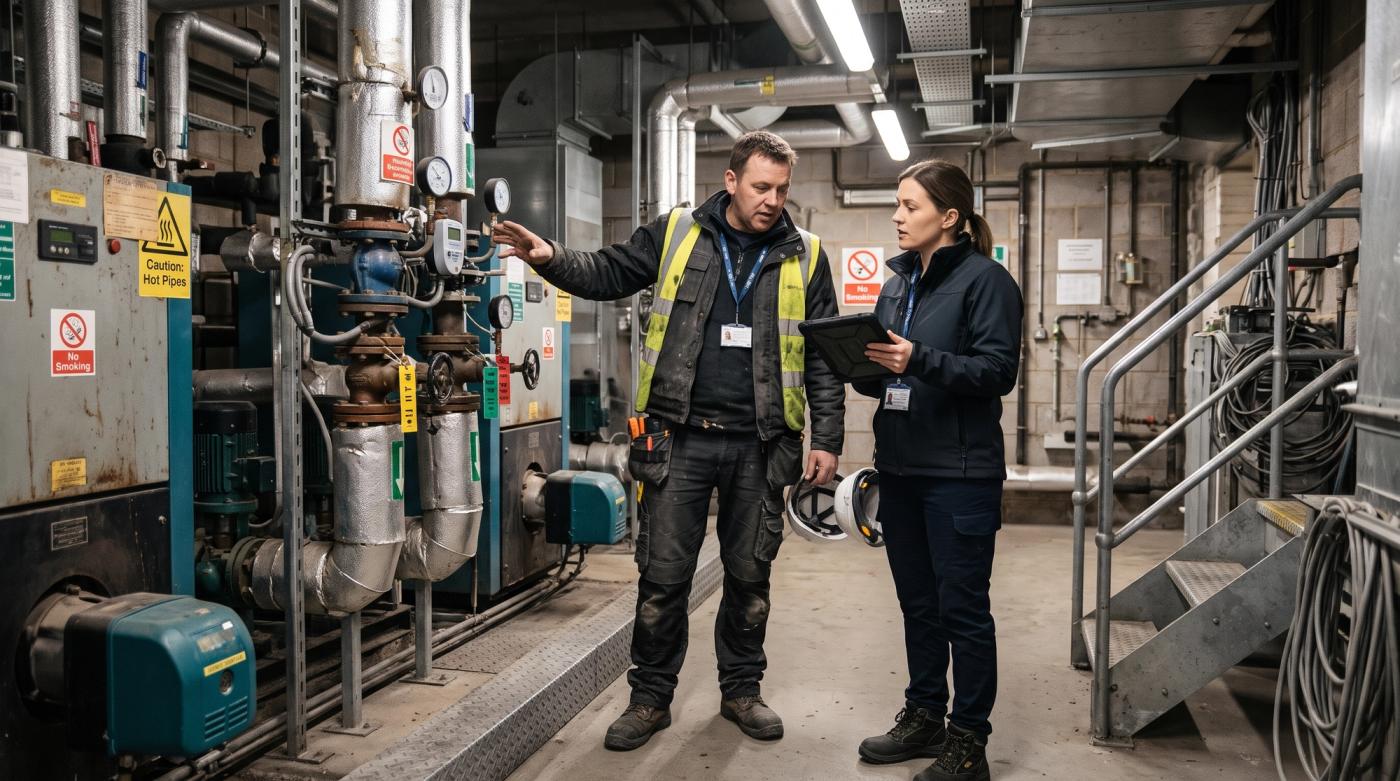
One good managing agent could be worth more than a hundred one-off enquiries.
If you run a property maintenance company, you'll know the difference between being busy and building a business.
You can spend every week quoting for repairs, organising tradespeople, dealing with emergencies and trying to keep the diary full.
But when those jobs finish, you're back to finding the next customer.
Commercial property maintenance contracts offer a different opportunity.
A relationship with a managing agent, commercial landlord or facilities management company could provide regular work, predictable maintenance schedules and opportunities across several buildings.
The challenge is getting your business in front of the people who control that work.
This guide explains how to find property maintenance contracts, approach commercial decision-makers, become an approved contractor and build relationships that generate repeat business.
1. Stop looking for jobs. Start looking for relationships.
There's an important difference between winning a maintenance job and winning a maintenance customer.
A business might pay you £350 to repair a damaged door. That's useful work, but once the repair is finished, the transaction may be over.
Now imagine a managing agent responsible for 25 commercial properties.
That agent might regularly need contractors for:
- General building repairs
- Planned preventative maintenance
- Plumbing and drainage
- Electrical maintenance
- Roofing and guttering
- Painting and decorating
- Emergency call-outs
- Vacant property works
- Minor refurbishment projects
You might not provide all those services, and the managing agent might already have preferred contractors.
But if your business becomes a trusted supplier for work within your capabilities, that relationship could create opportunities across multiple properties.
The commercial prize isn't necessarily the individual job. It's becoming a company that someone responsible for multiple buildings knows they can rely on.
That changes how you should approach finding new customers.
Instead of simply searching for people who need a repair today, start identifying organisations that regularly commission the type of work you do.
2. Know which maintenance contracts suit your business
Not every property maintenance contract is worth pursuing.
Before approaching commercial customers, establish what your business can deliver profitably and reliably.
Consider your strengths.
Are you particularly good at reactive repairs for occupied commercial buildings? Do you have the workforce and systems to manage planned maintenance? Can you offer out-of-hours emergency response?
Your ideal contracts will depend on several factors.
Geography: A portfolio of properties close together may be much more efficient to service than individual sites spread across the country.
Trade capabilities: Be clear about which services your team delivers directly and which require specialist subcontractors.
Response times: Some customers need attendance within agreed timeframes. Don't promise emergency coverage you cannot consistently provide.
Contract size: A large portfolio might generate substantial revenue but demand more administration, supervision and working capital.
Payment terms: Commercial customers may have approval and invoicing processes that affect cash flow.
Compliance: Certain work requires appropriate qualifications, registrations or competent specialists.
For example, gas work must be undertaken by appropriately Gas Safe registered engineers. Electrical work and other specialist activities may also carry particular competence and safety requirements.
The best maintenance contract is one your business can deliver well while making a sustainable profit.
3. Find the companies that control commercial maintenance work
Here's where your approach can become considerably more effective.
Many maintenance businesses focus their prospecting on individual premises.
They search for offices, shops, warehouses and industrial units that might need repairs.
That's not necessarily wrong.
But there may be greater leverage in identifying the organisations responsible for maintaining multiple premises.
Commercial property managing agents
Managing agents act on behalf of property owners and may coordinate maintenance across portfolios of offices, retail premises, industrial estates and other commercial buildings.
Depending on their responsibilities, they might appoint contractors directly or make recommendations to landlords and clients.
Research managing agents operating in your service area and examine the types of properties they manage.
A firm specialising in commercial industrial estates could be particularly relevant if your company already maintains warehouses and industrial premises.
Facilities management companies
Facilities management providers may deliver some services themselves while subcontracting specialist or regional maintenance work.
Smaller maintenance businesses can sometimes find opportunities as subcontractors, particularly where they offer reliable local coverage or a specialist capability.
However, larger providers may have established supply chains and formal onboarding requirements.
Commercial landlords and property investors
Some landlords manage maintenance directly, particularly where they own multiple commercial properties.
Others delegate the responsibility to managing agents.
Understanding who actually authorises work will save you time contacting the wrong organisation.
Multi-site businesses
Retail groups, hospitality operators, healthcare businesses and other organisations with several premises may coordinate maintenance centrally.
If your company has the coverage and capacity, these can be relevant potential customers.
But don't assume that the manager of an individual branch has authority to appoint contractors.
A faster way to identify potential customers
Finding suitable managing agents, property operators and facilities companies can take hours of research.
MoreAboard's B2B lead generation service helps identify 30 potential business customers using your maintenance company's website and an example of the kind of customer you'd love to work with.
Each prospect comes with contact information and an individual reason to consider approaching them.
It's designed to reduce the research, not replace the relationship-building.
4. Get onto approved contractor lists
For many commercial maintenance companies, becoming an approved supplier is an important step towards winning repeat work.
Managing agents and facilities companies often need confidence that contractors can work safely, respond reliably and meet their administrative requirements.
Before approaching them, prepare a straightforward contractor information pack.
Depending on the work and the customer's requirements, it could include:
- Company details and service coverage
- Public and employers' liability insurance, where applicable
- Relevant qualifications and trade registrations
- Health and safety policy
- Risk assessment and method statement procedures
- Evidence of relevant experience
- Customer references
- Emergency contact arrangements
- Relevant accreditations, where required
Some customers may request schemes such as CHAS or SafeContractor, although requirements vary. Neither should be presented as universally compulsory.
Ask about the supplier onboarding process
Instead of immediately asking a managing agent whether they have work available, try asking:
"Do you maintain an approved contractor list for commercial property repairs and maintenance? We'd be interested in understanding your requirements for joining it."
That's a more useful question than a generic request for work.
You may discover that the company isn't currently appointing contractors, but reviews its supply chain periodically.
Or it may have a particular gap in local coverage.
Either way, you've learned something about how that organisation buys maintenance services.
Getting onto a supplier list doesn't guarantee work. But understanding the buying process is often more productive than repeatedly sending quotations to businesses that aren't looking for them.
5. Find the right person to approach
Commercial property maintenance decisions don't always sit with the building owner.
Depending on the organisation, relevant contacts might include:
- Property managers
- Facilities managers
- Building managers
- Estates managers
- Operations directors
- Maintenance managers
- Procurement or supply chain managers
A property manager may oversee day-to-day contractor appointments but require landlord approval for major expenditure.
A facilities manager may control reactive maintenance but use a central procurement team for planned contracts.
And some organisations appoint one principal contractor who manages the wider supply chain.
Before sending an introduction, try to establish who is responsible for the type of work you provide.
Company websites, professional networks and legitimate business contact sources can help you identify suitable people or contact routes.
A general business email address can also be a useful starting point.
Make sure any direct marketing complies with applicable UK data protection and electronic marketing requirements.
6. Approach managing agents like a potential supplier, not a salesperson
A commercial property manager's day can be dominated by tenant complaints, contractor delays, urgent repairs and competing demands from landlords.
They generally don't need another vague email saying a company offers "high-quality maintenance services at competitive prices".
They need to know whether you can make their working life easier.
That means demonstrating practical relevance.
For example:
Subject: Commercial property maintenance support — Peterborough
"Hi Sarah,
We provide reactive repairs and planned building maintenance for commercial premises across Peterborough and the surrounding area.
I noticed your company manages commercial properties locally and wanted to introduce ourselves as a potential maintenance contractor.
We cover general building repairs, minor refurbishment and emergency maintenance, with a particular focus on occupied commercial premises.
If you review your contractor network periodically, I'd be happy to send over our capabilities and insurance details.
Kind regards"
The message is simple, but it communicates useful information.
It establishes location, services, relevant experience and a clear next step.
Crucially, it doesn't claim the recipient needs a contractor or suggest that their current suppliers are unreliable.
What makes a maintenance contractor attractive?
Often, it's the things that reduce problems for the person managing the building.
Turning up when promised.
Communicating clearly with tenants.
Providing photographs of completed work.
Explaining additional costs before undertaking them.
Submitting invoices with the correct references.
Keeping the site safe and tidy.
None of these is particularly glamorous.
But for someone coordinating repairs across multiple properties, dependable administration and communication can be just as valuable as technical workmanship.
You're not only selling repairs. You're selling fewer problems for the person responsible for the property.
7. Understand the difference between reactive and planned maintenance contracts
These two types of work can have different commercial characteristics.
Reactive maintenance
Reactive work involves responding to faults, damage and unexpected problems.
Examples include leaking pipes, damaged doors, electrical faults and emergency repairs.
It can provide regular opportunities, particularly through managing agents, but workloads may be unpredictable.
Some customers operate agreed schedules of rates or call-out arrangements rather than guaranteeing a fixed volume of work.
Planned preventative maintenance
Planned maintenance involves scheduled work intended to keep buildings and equipment in suitable condition.
Depending on your capabilities, this could include routine inspections, servicing, gutter clearance, fabric maintenance and other recurring tasks.
Planned work can make staffing and scheduling easier to forecast.
However, it may involve detailed service specifications, reporting requirements and contractual performance measures.
Which is better?
That depends on your business.
A small multi-trade maintenance company might initially find opportunities through reactive repairs and then develop longer-term relationships.
A specialist contractor with established servicing capabilities might prefer scheduled maintenance agreements.
Some customers require both.
The important thing is to understand what you're pricing and whether the arrangement provides guaranteed work or merely access to potential call-outs.
8. Find property maintenance tenders and larger opportunities
Some commercial maintenance contracts are awarded through formal procurement.
This is particularly relevant for public estates, housing providers, educational organisations and larger facilities management arrangements.
Useful UK procurement sources include:
- Find a Tender
- Contracts Finder
- Procurement portals used by individual organisations
Search for terms such as property maintenance, building maintenance, planned preventative maintenance, reactive repairs and facilities management.
Before bidding, examine the requirements carefully.
Consider geographic coverage, service levels, insurance, qualifications, contract value, payment arrangements and any previous experience requirements.
A contract covering hundreds of buildings may look attractive but could require operational resources well beyond a small contractor's current capacity.
Also distinguish between winning a place on a framework and receiving guaranteed work. Framework appointments don't necessarily result in orders.
For many smaller businesses, building direct relationships with commercial managing agents may be a more practical starting point than competing for large public contracts.
9. Make your first contract the beginning of a longer relationship
Winning a first job from a managing agent is an opportunity to demonstrate how your business operates.
The initial repair might be small.
Perhaps you're asked to fix a damaged fire door closer, repair a ceiling following a leak or undertake minor works in a vacant unit.
How you handle that job can influence whether you're considered again.
Confirm the scope.
Arrive when agreed.
Communicate any complications.
Document completed work.
Invoice accurately.
And follow up appropriately to make sure the customer has what they need.
Make it easy to give you the next job
A useful practice is to keep a record of the customer's preferred procedures.
Who authorises quotations?
How should completion photographs be submitted?
Does each job require a purchase order?
What information must appear on invoices?
Who should be contacted if work uncovers an additional problem?
Learning these details helps you become easier to work with.
For a busy property manager, that matters.
Over time, a dependable contractor can become a familiar and trusted option when suitable work arises.
The first job proves you can do the work. The next ten depend on whether the customer wants to work with you again.
10. Price commercial maintenance contracts for profit, not just turnover
Recurring work can be attractive, but it isn't automatically profitable.
Before agreeing to a maintenance arrangement, consider the full cost of delivery.
That might include:
- Labour and employer costs
- Travel between properties
- Materials and consumables
- Specialist subcontractors
- Equipment and vehicles
- Administration and reporting
- Supervision
- Emergency and out-of-hours coverage
- Insurance and compliance
- Unproductive time between jobs
Commercial customers may also require particular response times or pricing structures.
If a contract demands rapid attendance across a wide geographical area, your costs could be significantly higher than for planned work within a compact service area.
Be particularly careful with fixed-price arrangements where the scope is unclear.
A steady stream of low-margin jobs can keep your team busy without generating enough profit to grow.
The aim isn't to win the most maintenance work. It's to win the right work at the right price.
11. Find more commercial maintenance customers without spending evenings researching
Suppose your business already maintains several office buildings for a local property management company.
You'd love more customers like that one.
You know the work, understand the expectations and have the people and equipment to deliver it.
The next challenge is finding other organisations with similar requirements.
You could spend evenings searching for managing agents, examining property portfolios, identifying contacts and working out which companies might be worth approaching.
Or you could use that existing customer relationship as the starting point for more focused research.
That's what MoreAboard is designed to help with.
Your best customer. ×30.
You provide two websites.
Your property maintenance company's website, so we can understand what you offer.
And the website of a business you'd love to have as a customer, giving us a practical example of the kind of organisation you want to win.
MoreAboard then researches 30 potential business customers, providing:
- 30 companies selected for commercial relevance.
- 30 contacts or useful business contact points.
- 30 email addresses to help you make introductions.
- 30 individual reasons to approach explaining why each business could be relevant.
Your results are delivered through an online dashboard, with a downloadable PDF.
And if a contact is invalid or outdated, our replacement promise provides a substitute.
£99 once. No subscription. No agency retainer.
The standard price is £199.
Find my 30 potential customers
These are researched prospects, not confirmed maintenance enquiries or guaranteed contracts. You decide which companies to approach and handle the subsequent sales conversations.
12. What could one good managing agent relationship be worth?
Consider a hypothetical example.
A commercial managing agent appoints your maintenance company for occasional reactive repairs across its portfolio.
Over the course of a year, you complete 20 jobs averaging £450 each.
That's £9,000 in annual revenue.
If the relationship develops and the agent begins commissioning additional planned work, the commercial value could increase.
But the opposite is also possible. The agent may have limited work available, and being approved as a contractor doesn't guarantee a particular number of jobs.
Revenue also isn't profit. Labour, materials, travel and overheads must all be accounted for.
The point is that a single relationship with the right organisation can create opportunities beyond a single repair.
That's why researching suitable customers can be more valuable than simply collecting large numbers of unrelated enquiries.
Frequently asked questions
How do I get property maintenance contracts?
Identify the types of maintenance work your company can deliver reliably, then research commercial managing agents, landlords, facilities management providers and multi-site businesses. Find the people responsible for contractor appointments, introduce your services and ask about supplier onboarding requirements.
How do I get commercial maintenance contracts?
Focus on organisations that regularly commission maintenance for commercial buildings. Prepare evidence of your experience, insurance and relevant qualifications. Build relationships with property and facilities managers, and pursue suitable private-sector opportunities or formal tenders.
How do I get work from property management companies?
Research property management companies operating in your area and establish whether they appoint maintenance contractors. Contact the appropriate property manager or supplier onboarding team with a concise explanation of your services, geographic coverage and relevant experience.
How do I become an approved maintenance contractor?
Requirements vary by organisation. You may need to provide insurance documents, qualifications, health and safety information, references, financial details and relevant accreditations. Ask the prospective customer about its specific approval process.
Are property maintenance contracts profitable?
They can be, provided they're priced correctly and delivered efficiently. Consider labour, materials, travel, administration, response times and overheads before committing. Recurring revenue doesn't necessarily mean recurring profit.
Where can I find building maintenance tenders?
Public-sector opportunities may be advertised through Find a Tender, Contracts Finder and individual procurement portals. Private organisations may operate separate tendering and supplier selection processes.
Can MoreAboard help me find commercial maintenance customers?
Yes. MoreAboard uses your company's website and an example of an ideal customer to research 30 potential business customers, with contact details, email addresses and individual reasons to approach. It doesn't guarantee that those businesses are actively seeking a maintenance contractor.
Your next maintenance contract could start with one introduction
You don't need to spend every evening searching for another repair job.
You need more relationships with businesses that regularly commission the kind of maintenance work you do best.
For some contractors, that could mean commercial landlords. For others, managing agents, facilities providers or multi-site businesses.
The right customer isn't necessarily the one offering the biggest job today.
It might be the one that keeps coming back for years.
Stop chasing everyone. Start approaching the right ones.
Your Best Customer. ×30.
Two websites. 30 researched opportunities. £99 once.
Find my 30 potential customers
MoreAboard provides B2B prospect research, not confirmed customer enquiries, appointments or guaranteed contracts. Any subsequent outreach must comply with applicable UK data protection and marketing requirements.